
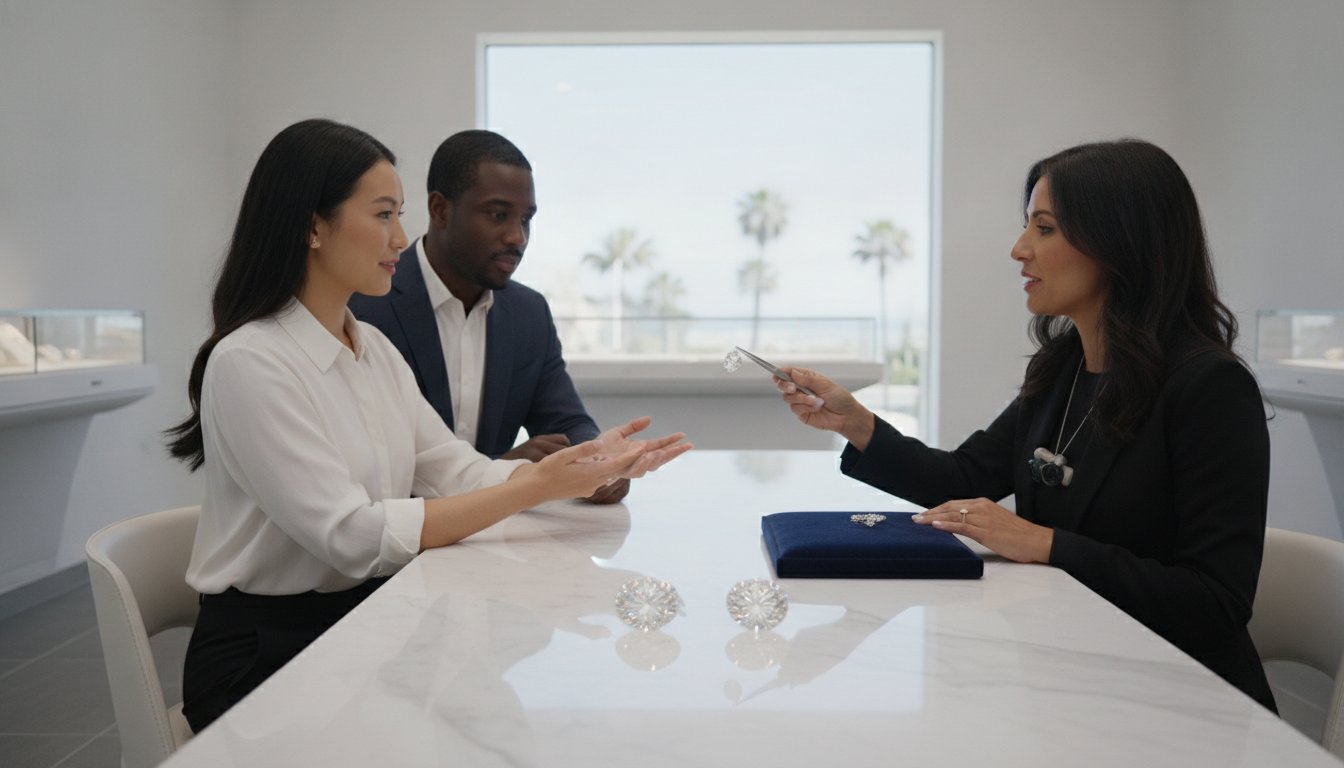
What if the most significant investment of your life was based on a digital render rather than the stone's actual fire and brilliance? You've likely spent hours browsing online, only to feel more confused by conflicting terms and the fear of accidentally choosing a simulated stone. When you're searching for real diamond rings, the process should feel like a celebration of your commitment, not a high-stakes gamble. It's completely natural to feel overwhelmed by technical jargon or the pressure of making a "blind" purchase from a corporate website. You want to know that what you're buying is authentic, ethical, and worth the value you're investing.
You deserve to feel absolute confidence in the authenticity and long-term value of your jewelry. This guide will show you how to distinguish between natural and laboratory-grown options while explaining why GIA certification remains the gold standard for your protection. We'll explore how to evaluate a stone's quality in a professional showroom setting and why seeing diamonds side-by-side here in San Diego is the only way to truly understand their character. From mastering the 4Cs to understanding why lab-grown diamonds now account for 61 percent of engagement rings in 2026, you'll gain the expert knowledge needed to choose a piece that stands the test of time.
Key Takeaways
- Understand the physical and chemical similarities between natural and laboratory-grown stones that define an authentic diamond lattice structure.
- Discover how GIA certification serves as an unbiased, non-profit safeguard for your investment in real diamond rings.
- Learn why evaluating a diamond's fire and scintillation in person is far superior to making a blind online purchase from a corporate retailer.
- Identify the professional care routines, such as regular prong inspections, required to maintain your ring’s brilliance for a lifetime.
What Defines a 'Real' Diamond Ring in 2026?
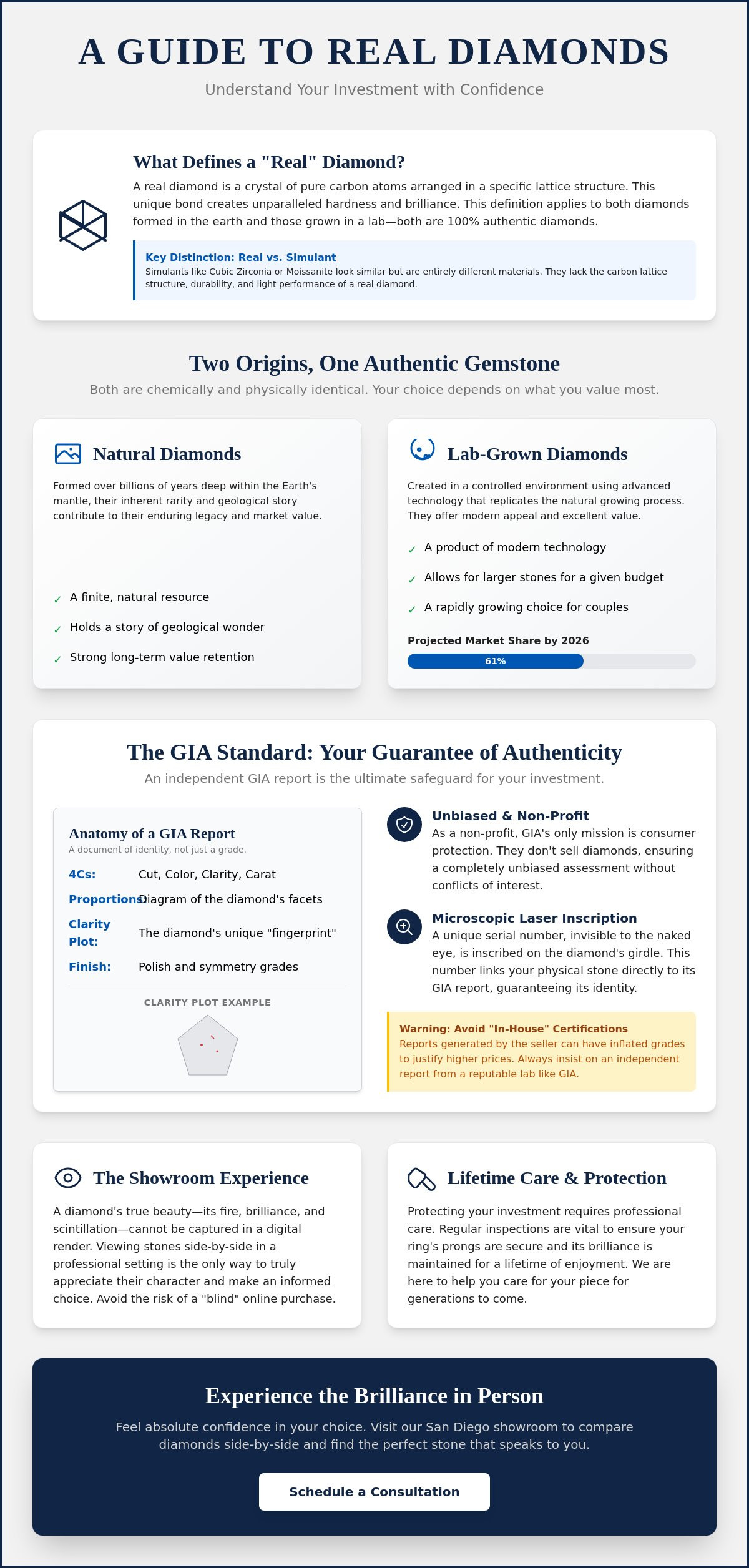
Understanding what defines a real diamond begins with the physical science of the stone. A real diamond is a crystal consisting of pure carbon atoms arranged in a specific diamond lattice structure. This unique atomic bond is what gives the gem its world-renowned hardness and unmatched brilliance. When you search for real diamond rings, you're looking for this specific mineral composition, which sets it apart from any other gemstone or imitation.
It's vital to distinguish real diamonds from simulants like cubic zirconia or moissanite. While these alternatives might look similar to an untrained eye, they don't possess the same durability or light-handling properties. They are entirely different materials. Today, the term "real" describes the authenticity of the carbon structure itself. Whether the stone was formed by nature over billions of years or grown in a controlled environment, if it's carbon in a lattice structure, it's a diamond.
To explore the variety of these authentic structures and compare pricing, browsing a diverse selection of loose stones from an online specialist like Superlight Diamonds can be a helpful first step in your research process.
Natural vs. Laboratory-Grown: Understanding the Choice
Both natural and laboratory-grown diamonds are 100 percent real diamonds. They share the same refractive index and the same score of 10 on the Mohs scale of hardness. Your choice often depends on what you value most for your commitment. Lab-grown diamonds offer a modern appeal and allow for larger stones within a specific budget. However, you should also weigh the long-term value of diamonds when deciding, as natural and lab-grown stones behave differently in the market over time.
The Importance of Rarity in Real Diamond Rings
Natural diamonds are finite resources created deep within the earth's mantle. This inherent rarity is a significant factor in their enduring market value and appeal. Selecting a natural GIA certified diamond is often a choice for those who value legacy and heritage. These stones carry a story of geological wonder that spans eons. When you visit our San Diego showroom, we'll show you these options side-by-side so you can feel the history and character of a mined stone for yourself.
The GIA Standard: How Certification Guarantees Authenticity
When you invest in real diamond rings, you need more than just a verbal promise of quality. The Gemological Institute of America (GIA) serves as the world's most trusted authority because they don't sell diamonds. As a non-profit organization, their focus remains entirely on protecting the consumer through unbiased research and grading. Every stone sent to their laboratory undergoes a rigorous assessment that removes the conflict of interest often found in retail environments.
One of the most critical security features provided by the GIA is the laser inscription process. A microscopic serial number is etched directly onto the diamond's girdle, visible only under magnification. This unique identifier matches the physical grading report exactly. It allows you to verify that the stone you are viewing is the same one described on the paper, creating an immutable link between the gem and its credentials. You should never purchase a high-value stone without an accompanying independent lab report to verify its identity.
Anatomy of a GIA Diamond Grading Report
The grading report provides a comprehensive breakdown of the 4Cs: Cut, Color, Clarity, and Carat weight. Beyond these basics, the "Proportions" and "Clarity Plot" sections offer deeper insight. The clarity plot acts as a diamond's unique fingerprint, mapping the internal characteristics that distinguish your stone from every other stone in the world. A GIA report is a document of identity, not just a grade. This level of detail is vital for evaluating real diamond rings before you make a commitment.
Avoiding the Risks of 'Self-Certified' Jewelry
We strongly advise against relying on "in-house" certifications. These reports are generated by the seller rather than an independent laboratory, which can lead to inflated grades used to justify higher price points. An independent GIA report ensures the grade you are paying for is accurate and honest. To help you spot these and other misleading sales tactics, we've developed a diamond seller myths guide. If you're currently comparing stones and feel unsure about a report, please contact us for a clear and honest perspective.
Evaluating Real Diamond Rings: The Showroom Experience
While digital renderings and online filters offer convenience, they can't capture the soul of a gemstone. Real diamond rings are physical objects that interact with light in complex ways. A static image on a screen won't show you how a stone's fire reacts as you move your hand or how its scintillation changes under different conditions. Seeing a diamond in person is the only way to truly verify its character and beauty.
The role of lighting is paramount in this process. While professional showroom lighting highlights a stone's maximum brilliance, we also encourage you to view options in diffused or natural light. This reveals the diamond's true performance. Additionally, comparing different engagement ring styles side-by-side shows you how various settings, like halos or three-stone designs, can alter the perceived size and sparkle of the center stone.
Viewing Diamonds Side-by-Side
Two diamonds with identical GIA grades on paper can have completely different personalities. One might have a more pleasing pattern of light return, while another feels less vibrant. By placing stones next to each other, you can define your personal preferences. For instance, comparing a 1-carat stone against a 1.5-carat stone helps you visualize exactly how much finger coverage feels right for your hand shape and lifestyle.
The Advantage of Local Expertise in San Diego
Choosing a local partner means you're investing in a relationship that extends far beyond the initial purchase. We pride ourselves on being a transparent alternative to corporate chains, offering a neighborly spirit and a commitment to lifelong care. We invite you to book an appointment for a private viewing at our showroom. Whether you're coming from downtown San Diego or North County, our goal is to provide an educational journey that leaves you feeling confident. If you have specific questions about our current collection, please contact us to speak with an expert today.
Longevity and Care: Protecting Your Investment
Selecting one of our real diamond rings is the beginning of a beautiful, lifelong story. To ensure your jewelry remains as radiant as the day you first wore it, regular professional upkeep is essential. Diamonds are incredibly durable, but the precious metal settings that hold them require consistent care. We recommend scheduling a professional cleaning and prong inspection every six months. Daily wear can lead to loosened prongs or a buildup of oils that dull the stone's fire. By catching these minor issues early, you protect your investment and prevent the heartbreak of a lost stone.
Our role as your jeweler doesn't end when you leave our showroom. We view ourselves as a long-term partner in your ring's journey. Whether you need ring resizing after a few years or a professional prong retipping to secure your gem, our team provides the expert care your heirloom deserves. This personal approach is what distinguishes a local San Diego partner from a cold, high-volume corporate chain. We're here to stand behind our work indefinitely, celebrating your enduring commitment alongside you.
Custom Design as a Standard for Quality
Choosing custom jewelry design allows us to create a piece specifically tailored to your lifestyle and the unique proportions of your GIA diamond. We use advanced CAD modeling to ensure the setting's structural integrity is perfect from every angle. This process results in a more durable ring that can withstand an active lifestyle while perfectly showcasing the stone's brilliance. It's a standard of craftsmanship that mass-produced rings simply can't match.
The Role of Professional Appraisals
Securing the legacy of real diamond rings also involves proper documentation for insurance purposes. As market values for natural diamonds fluctuate, an outdated appraisal might leave you underinsured. We provide detailed insurance appraisals to reflect the current replacement value of your jewelry. Having this professional documentation is the final, vital step in ensuring your piece is protected for generations to come.
Begin Your Diamond Journey with Confidence
Investing in a diamond is a significant milestone that deserves absolute transparency and expert guidance. You now understand how GIA certification serves as your ultimate safeguard and why the physical showroom experience is vital for identifying a stone's unique personality. Whether you choose a natural or laboratory-grown gem, your focus should always remain on verified quality and the promise of lifelong care. This principled approach ensures your jewelry remains as brilliant as the day you first saw it.
Selecting from the many available real diamond rings requires a partner who values your investment as much as you do. Our team provides a welcoming, educational environment where you can compare ethically sourced stones side-by-side without the pressure of corporate sales tactics. With GIA-certified experts on-site and two convenient San Diego locations, we're here to help you explore every detail of your selection. We invite you to schedule a private consultation at our San Diego showroom to view our GIA certified collection. We look forward to helping you find a piece that perfectly reflects your unique story and enduring commitment.
Frequently Asked Questions
How can I tell if a diamond ring is real at home?
While at-home tests like the fog test provide a quick indication, they aren't foolproof methods for verifying real diamond rings. You can check the girdle of the stone for a microscopic GIA laser inscription using a jeweler's loupe. However, professional thermal and electrical conductivity testing is the only way to be certain. We recommend visiting our San Diego showroom for a professional assessment rather than relying on home experiments that can be misleading.
Is a lab-grown diamond considered a 'real' diamond?
Yes, lab-grown diamonds are 100 percent real diamonds with the exact same chemical, physical, and optical properties as natural stones. They aren't simulants like cubic zirconia. Instead, they consist of the same carbon lattice structure. The only difference is their origin. Because they're real, they require the same GIA certification to verify their quality and ensure you're making an informed decision for your engagement ring.
Why is GIA certification better than other diamond reports?
GIA certification is considered the gold standard because the Gemological Institute of America is a non-profit research institution. Unlike some labs that may inflate grades to help retailers, the GIA provides an unbiased, third-party assessment. Their grading standards are the most rigorous in the industry. This ensures that the color and clarity grades you see on a report for real diamond rings are accurate and honest, protecting your investment.
Do real diamond rings hold their value over time?
Natural diamonds have a long history of maintaining value due to their inherent rarity and finite supply. While market prices can fluctuate, a high-quality natural stone often serves as a lasting asset. Lab-grown diamonds, while physically identical, have seen price stabilization as production technology matures in early 2026. We focus on helping you understand these market dynamics so you can choose a ring that aligns with your personal values and long-term goals.
What is the difference between a real diamond and a moissanite ring?
A diamond consists of pure carbon, while moissanite is made of silicon carbide. Although moissanite is durable, it's a different mineral entirely. It often displays a "disco ball" effect with more colorful flashes of light than a diamond's white light return. Diamonds are also harder, scoring a 10 on the Mohs scale compared to moissanite's 9.25. Seeing them side-by-side in our showroom makes these visual differences immediately clear.
Article by
Ariel Berko
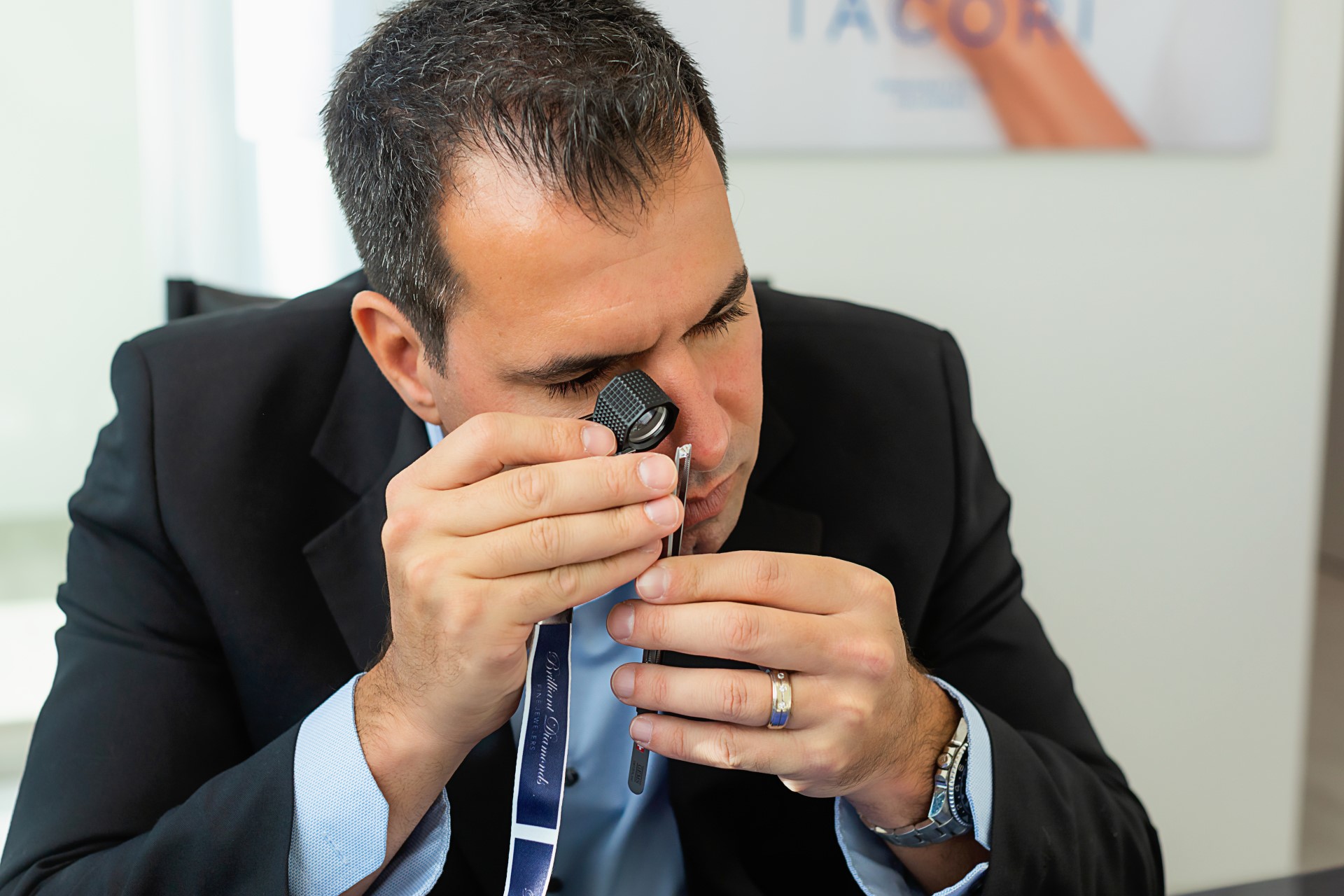
Ariel has been working in the diamond industry in San Diego since 1995, bringing decades of hands-on experience and a deep-rooted family background in fine jewelry. A graduate of the Gemological Institute of America (GIA), he is highly trained in diamonds and known for his expertise in both diamond selection and custom jewelry design.
Over the years, Ariel has built a reputation for guiding clients with honesty, precision, and a personalized approach—helping them confidently choose diamonds and create pieces that are both meaningful and enduring.


