

A diamond's true beauty isn't found on a grading report; it's found in the way light dances across its facets when you see it in person. You've likely spent hours scrolling through online inventories, only to feel more confused by technical growth methods and cryptic certificates. It's natural to feel overwhelmed when the difference between a stunning stone and a dull one isn't always listed on a spreadsheet. We understand that this is one of the most significant purchases you'll ever make, and you deserve a partner who values your investment as much as you do.
This guide will teach you exactly how to choose a lab grown diamond that offers maximum brilliance and lasting value for your investment. We'll break down the nuances of CVD versus HPHT growth, explain how to avoid common pitfalls like blue nuance or brown tints, and share why a side-by-side comparison in our San Diego showroom is the ultimate way to secure your perfect stone. By the end of this expert guide, you'll have the confidence to spot a high-quality lab diamond and the peace of mind that comes with a truly informed decision.
Key Takeaways
- Understand that lab-grown diamonds are chemically and physically identical to natural stones, offering the same structural integrity and brilliance for a lifetime.
- Master how to choose a lab grown diamond by looking beyond the grading report to identify subtle optical issues like blue nuance or brownish tints.
- Prioritize the cut quality above all other factors, as the precision of the facets is what truly determines a diamond's fire and light performance.
- Learn how to leverage the specific growth methods of lab stones to select a color grade that maximizes your budget without compromising a bright, white appearance.
- Recognize the importance of side-by-side comparisons at our San Diego showroom to verify the stone's beauty in person before making your final selection.
Understanding Lab Grown Diamonds: Mechanism and Authenticity
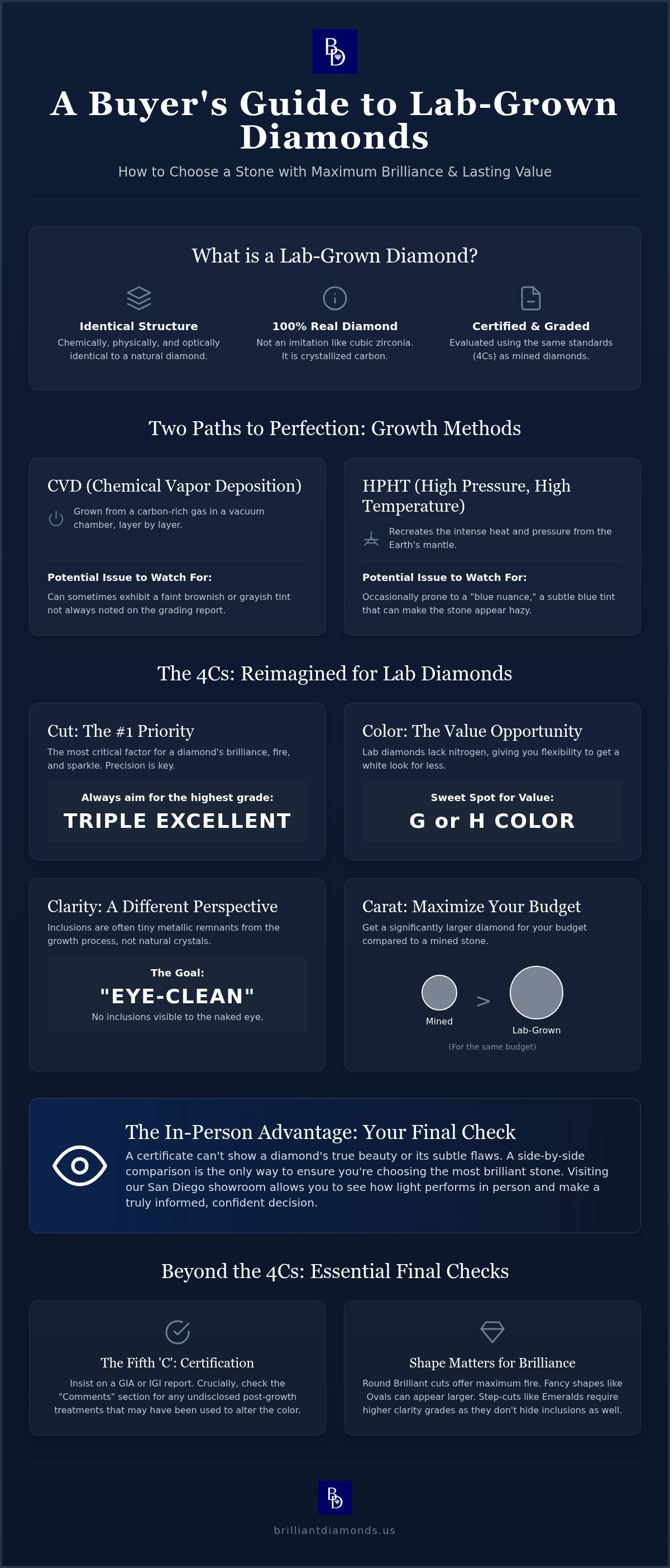
In 2026, the jewelry world has moved beyond the debate of "natural versus lab." Lab-grown diamonds have firmly established themselves as a standard for modern luxury. These stones are not imitations like cubic zirconia or moissanite; they are 100% crystallized carbon. They share the identical chemical, physical, and optical DNA of diamonds formed deep underground. Understanding this scientific reality is the first step in learning how to choose a lab grown diamond that offers the same fire and longevity as any mined stone.
This same scientific breakthrough also allows for deeply personal applications. For those seeking a unique way to honor a legacy, Diamond Cremations utilizes these advanced growth methods to create certified memorial diamonds from the cremated ashes or hair of loved ones and pets.
CVD vs. HPHT: Which Growth Method is Superior?
Modern technology utilizes two distinct paths to create a synthetic diamond. Chemical Vapor Deposition (CVD) uses a carbon-rich gas that settles onto a diamond seed, mimicking the way carbon forms in interstellar gas clouds. High Pressure High Temperature (HPHT) recreates the crushing weight and intense heat of the earth's mantle. While both produce stunning results, they carry unique risks. HPHT stones are occasionally prone to a subtle "blue nuance," while CVD stones can sometimes exhibit a faint brownish or gray tint. We'll help you identify these nuances when you visit our San Diego showroom for a side-by-side comparison.
Are Lab Diamonds Real? Addressing the Authenticity Myth
The Federal Trade Commission (FTC) defines these stones as real diamonds. Because they are structurally identical to mined counterparts, even a professional jeweler cannot distinguish between them using a standard loupe. Only specialized laboratory equipment can detect the specific growth patterns that identify a stone's origin. For a more detailed breakdown of these two categories, you can read our Lab Grown vs. Natural Diamonds: The Essential 2026 Comparison Guide. Choosing a stone is about your personal values and the beauty you see with your own eyes.
The 4Cs of Lab Diamond Selection: Beyond the Certificate
Selecting a stone requires a deeper look than just reading a piece of paper. When learning how to choose a lab grown diamond, you'll find the standard 4Cs (Cut, Color, Clarity, and Carat) still apply, but with modern technical twists. Cut remains the absolute king of brilliance. A poorly cut stone will look lifeless regardless of its size. In lab environments, growers can achieve incredible precision, so you should never settle for less than a "Triple Excellent" rating to ensure your diamond captures and reflects every ray of light.
Color grading offers a unique opportunity for value. Most lab diamonds are Type IIa, the purest form of carbon, meaning they lack the nitrogen that causes yellow tints in natural stones. This often allows you to "buy down" to a G or H color while still maintaining a bright, ice-white appearance. Clarity is also different in the lab. Instead of feathers or crystals, you might see microscopic growth remnants. The most exciting shift is in Carat weight. Because lab stones are more accessible, you can often select a significantly larger center stone for your engagement rings without exceeding your budget. Understanding these nuances is essential when researching how to choose a lab grown diamond that truly sparkles.
The 'Fifth C': Certification and Grading Reports
In 2026, transparency is everything. Always look for GIA or IGI certificates that explicitly state if the stone has undergone post-growth treatments to "fix" its color. These treatments aren't necessarily bad, but they should be disclosed per the FTC Jewelry Guides. We believe in providing full visibility so you can feel confident in the longevity of your purchase. If you have questions about a specific report, feel free to reach out to our local experts for a clear explanation.
Selecting the Perfect Shape for Brilliance
Your choice of shape affects how inclusions and tints are hidden. While Round Brilliant is the gold standard for fire, fancy shapes like Ovals or Radiants are excellent for maximizing surface area. Step cuts like Emerald or Asscher require higher clarity because they don't have the "crushed ice" look to hide growth remnants. If you're curious about how different styles perform, our guide on Exploring Diamond Ring Cuts offers a deep dive into aesthetic choices and light performance.
Spotting Quality Issues: What the Reports Don't Tell You
A grading report is a helpful map, but it isn't the landscape. When you're learning how to choose a lab grown diamond, you must look beyond the certificate to find visual issues that grading labs often overlook. For instance, HPHT stones can suffer from "blue nuance," a faint blue tint caused by boron used in the growth process. This gives the diamond a cold, steely appearance that isn't always reflected in the color grade. Conversely, CVD diamonds sometimes show a brownish or muddy tint due to the speed of their growth, even if they're graded as a high-quality "G" or "H" color.
Another hidden issue is internal strain or striation. If a diamond is grown too quickly, it can develop microscopic graining lines that disrupt the flow of light. This results in a "milky" or hazy appearance. A stone with this effect will never have the crisp, sharp sparkle you expect, regardless of its clarity grade. Identifying these subtle nuances is a critical part of knowing how to choose a lab grown diamond that will truly stand the test of time as a beautiful heirloom.
The Importance of Light Performance
Light performance is about more than just a "Very Good" cut grade. You should check fancy shapes like Ovals and Pears for "light leakage," which are areas where light passes through the bottom of the stone instead of reflecting back to your eye. A high-quality stone should exhibit vibrant scintillation and fire. These are the flashes of white and colored light that give a diamond its life. Two stones with identical grades can look completely different depending on how they handle light.
Inspecting Stones Under 10x Magnification
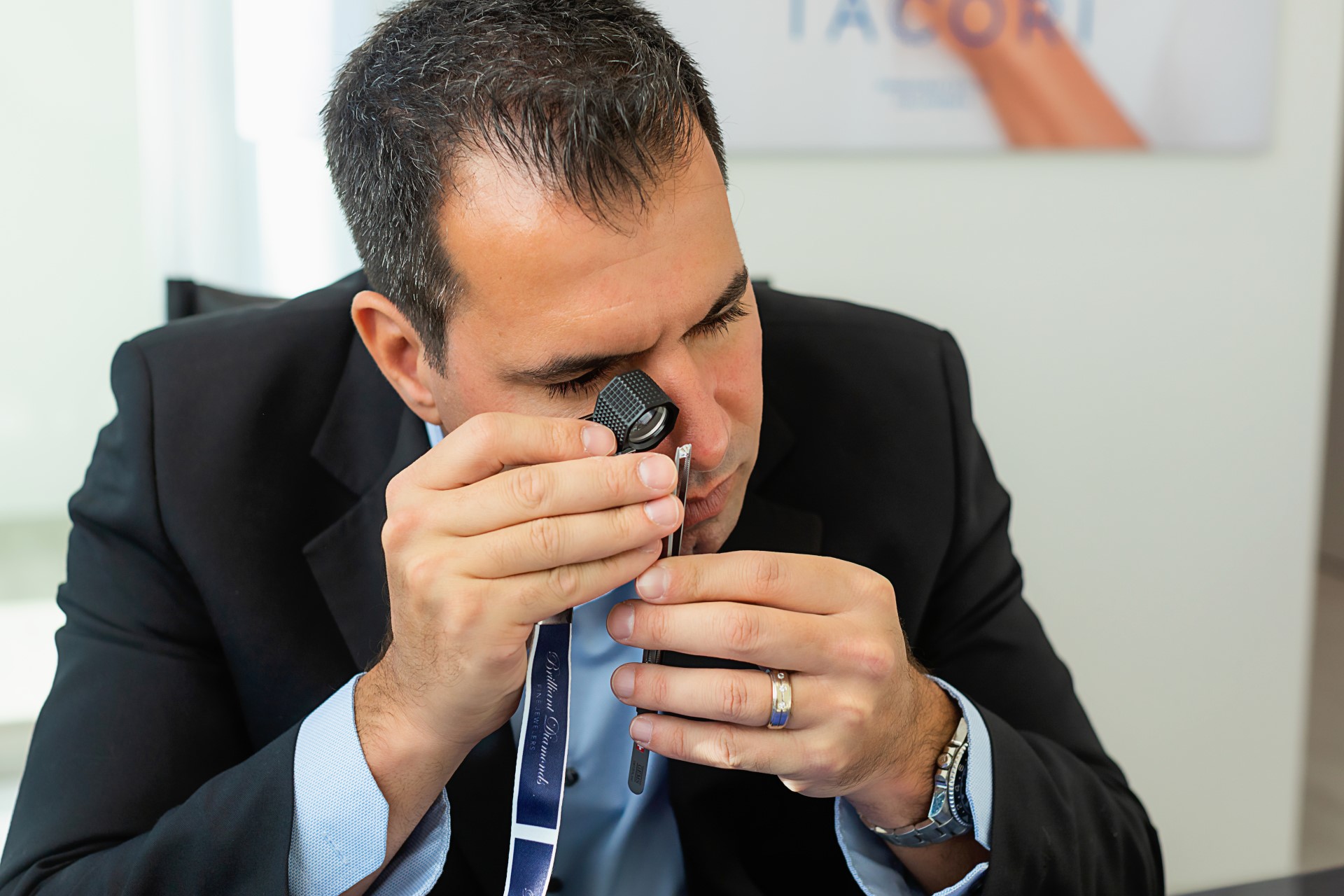
At our San Diego showroom, we vet every stone using a 10x jeweler's loupe. This allows us to spot growth-related striations that might be invisible to the naked eye but still impact the stone's overall transparency. We invite you to sit down with us and see these details for yourself so you can choose with absolute certainty. If you want to see the difference between a standard stone and a hand-selected one, speak with our diamond experts today.
The In-Person Advantage: Choosing Your Diamond in San Diego
Digital renderings and virtual try-on tools have come a long way, but they cannot replicate the way a diamond interacts with the vibrant, natural light of San Diego. Seeing stones side-by-side is the only definitive way to verify the subtle color nuances and light performance we have discussed. When you visit our showroom, you aren't just looking at a stone; you're observing how it responds to movement and different environments. This physical experience is the most reliable method for understanding how to choose a lab grown diamond that meets your personal standards for beauty and brilliance.
We encourage you to compare our laboratory-grown diamonds directly against our natural GIA-certified stones. This transparent approach removes the guesswork and helps you decide which path aligns best with your values and budget. You'll work directly with a local expert who focuses on your education rather than a high-pressure sale. We invite you to book an appointment to explore our curated collection and see these differences for yourself.
Pairing Your Stone with a Custom Setting
A diamond's appearance is heavily influenced by the metal that surrounds it. For example, a platinum or white gold setting can enhance the crisp, icy look of a high-color stone, while yellow gold can beautifully mask a warmer tint in a lower color grade. Our San Diego studio uses advanced CAD modeling to help you visualize your stone in a variety of styles. This ensures the final piece is a perfect reflection of your vision. You can learn more about our process for Custom Design to see how we bring these unique creations to life.
Long-Term Care and Community Trust
Choosing a diamond is a significant milestone, and we believe it should mark the start of a lifelong professional relationship. Unlike online-only retailers, a local partnership provides the security of immediate, hands-on care. From routine cleanings and inspections to prong retipping and resizing, having a trusted neighborhood jeweler ensures your investment remains protected. We take pride in standing behind our work and serving the San Diego community with integrity, gratitude, and expert craftsmanship for years to come.
Securing Your Perfect Brilliance
Selecting the ideal stone is a journey that blends technical precision with your personal aesthetic. You now understand that a grading report is only the beginning. By looking for subtle growth nuances like blue tints or strain lines, you can ensure your diamond possesses the crisp, sharp fire it deserves. Mastering how to choose a lab grown diamond means trusting your eyes as much as the certificate; especially when you have the opportunity to see the light performance in person.
Our commitment to you extends far beyond the initial purchase. We provide ethically sourced, sustainable options paired with expert consultations to guide your selection. By choosing a local partner, you gain access to lifetime care and professional maintenance that keeps your jewelry as radiant as the day you first wore it. We invite you to visit our San Diego showroom to compare lab-grown diamonds in person and experience the difference of a hand-selected stone. Your perfect diamond is waiting, and we're here to help you find it with absolute confidence.
Frequently Asked Questions
Do lab-grown diamonds hold their value over time?
Lab-grown diamonds do not typically appreciate in value like some rare natural stones; instead, they offer incredible upfront value for your budget. While they are a permanent asset, they should be viewed as a symbol of commitment rather than a financial investment. This is a key factor in how to choose a lab grown diamond if your priority is maximizing the size and quality of the stone for your immediate purchase.
Can you tell the difference between a lab-grown and a natural diamond with the naked eye?
No, you cannot distinguish between a lab-grown and a natural diamond with the naked eye because they share identical optical properties. Even a professional jeweler needs advanced laboratory equipment to detect the specific growth patterns that separate the two. This is why viewing stones side-by-side in our San Diego showroom is so helpful; you'll see that the sparkle and fire are indistinguishable.
Is it better to choose CVD or HPHT when buying a lab diamond?
Neither growth method is inherently superior, as both CVD and HPHT can produce world-class diamonds. CVD stones are sometimes prone to brownish tints, while HPHT stones can exhibit a subtle blue nuance. The best way to decide is to inspect the individual stone's light performance. We curate our collection to ensure every diamond meets our high standards, regardless of which technical method was used to grow it.
Can I insure a lab-grown diamond engagement ring?
Yes, you can and should insure your lab-grown diamond engagement ring just as you would a natural one. Most insurance providers offer comprehensive coverage for lab-grown jewelry against loss, theft, or damage. We provide professional insurance appraisals at our San Diego locations to ensure your piece is accurately documented for your policy.
Do lab-grown diamonds get cloudy or change color over time?
Lab-grown diamonds will never get cloudy or change color over time because they are 100% crystallized carbon. Unlike imitations like cubic zirconia, a lab diamond's clarity and color are permanent and stable for a lifetime. If a stone appears dull, it's likely due to surface oils or dirt, which can be easily resolved with a professional cleaning at our studio.
Article by
Ariel Berko
Ariel has been working in the diamond industry in San Diego since 1995, bringing decades of hands-on experience and a deep-rooted family background in fine jewelry. A graduate of the Gemological Institute of America (GIA), he is highly trained in diamonds and known for his expertise in both diamond selection and custom jewelry design.
Over the years, Ariel has built a reputation for guiding clients with honesty, precision, and a personalized approach—helping them confidently choose diamonds and create pieces that are both meaningful and enduring.


