

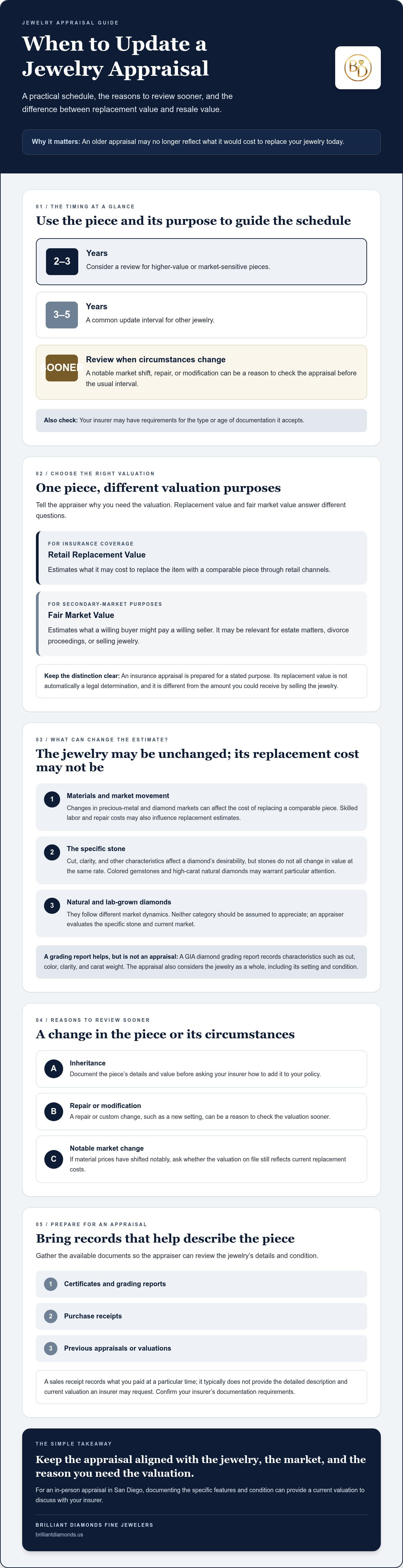
Could a five-year-old appraisal leave your engagement ring underinsured? If you’re wondering how often should jewelry be appraised, the answer depends on the piece, its condition, and changes in the market since its last valuation. An older appraisal may no longer reflect what it would cost to replace your jewelry today.
As a general guide, jewelry appraisals are commonly updated every three to five years. Higher-value or market-sensitive pieces may merit a review every two to three years. A major market change, a repair, or a modification can be a reason to check sooner. Your insurer’s documentation requirements also matter, so confirm what it needs before relying on an existing report.
This guide explains when to update an appraisal, how insurance replacement value differs from resale value, and what to bring to an appointment. If you’re in San Diego, an in-person appraisal can help document the specific features and condition of your jewelry and give you a current valuation to discuss with your insurer.
Key Takeaways
- Learn how often should jewelry be appraised and why regular updates can help keep insurance documentation aligned with current replacement costs.
- Understand how changes in precious metal and diamond markets may affect the value recorded for a particular piece.
- Know when an inheritance, repair, or custom modification may call for a new appraisal.
- Prepare for an in-person San Diego appraisal by gathering certificates, grading reports, receipts, and previous valuations.
Understanding the Ideal Frequency for Jewelry Appraisals
If you're asking how often should jewelry be appraised, use the piece and its purpose to guide the schedule. A review every two to three years may make sense for a high-value or market-sensitive item. Three to five years is a common interval for other jewelry, but a notable change in metal or diamond prices can make an earlier review worthwhile. An outdated appraisal may leave a difference between the documented replacement amount and the current cost of a comparable piece.
An insurance appraisal is a valuation document prepared for a stated purpose. Its replacement value is not automatically a legal determination, and it is different from the amount you could receive by selling the jewelry. A sales receipt records what you paid at a particular time; it typically does not provide the detailed description and current valuation an insurer may request. Check your policy’s requirements, including whether it specifies the type or age of documentation it accepts.
Retail Replacement Value vs. Fair Market Value
Retail Replacement Value estimates what it may cost to replace an item with a comparable piece through retail channels, which is why it is commonly used for insurance coverage. Fair Market Value estimates what a willing buyer might pay a willing seller in the secondary market. That valuation may be more appropriate for estate matters, divorce proceedings, or when selling to diamond buyers. Tell the appraiser why you need the valuation, since the right value depends on the purpose.
The Role of GIA Certification in Modern Appraisals
A GIA diamond grading report records characteristics such as a diamond’s cut, color, clarity, and carat weight. It gives an appraiser useful baseline information, but it is not itself an appraisal or a guarantee of current value. A current valuation also considers the jewelry as a whole, including its setting and condition.
For a natural diamond, changing market conditions can affect replacement estimates, so periodic review still matters. Bring the grading report, receipts, and earlier appraisals to help the appraiser document the piece. For a general overview of what an appraisal is, see Wikipedia’s explanation of the valuation process.
Why Market Volatility Dictates Your Appraisal Schedule
Your jewelry’s replacement value can change even when the piece itself has not. Gold prices approached $5,600 per ounce in late January 2026, while platinum prices had risen approximately 165% over recent periods as of April 2026, according to the research cited for this guide. Precious metals are part of a ring’s materials, so market shifts can affect the cost of replacing a comparable piece. The cost of skilled labor and fine jewelry repair may also influence replacement estimates.
That’s why how often should jewelry be appraised depends partly on its materials and how their markets are moving. Many appraisers suggest regular updates. If you notice a notable change in metal prices, ask whether the valuation on file still reflects current replacement costs. Your insurer can also clarify whether it needs an updated report.
Natural and lab-grown diamonds follow different market dynamics. Natural diamonds are finite, and rarity can contribute to the value of particular stones. Ethical sourcing may matter to buyers, but it does not automatically increase an appraisal value. Lab-grown diamond prices have been stabilizing rapidly, so an older valuation may not reflect today’s replacement market. Neither category should be assumed to appreciate; an appraiser evaluates the specific stone and current market.
The Impact of Gemstone Rarity
Cut and clarity can shape a diamond’s desirability, but stones do not all change in value at the same rate. Compare the details on your grading report with the appraiser’s description, and ask how the characteristics of your stone affect its replacement estimate. Explore how diamond ring cuts differ, and consider a closer review for colored gemstones or high-carat natural diamonds, whose rarity may warrant particular attention.
If you’re unsure how a market shift affects your coverage, contact Brilliant Diamonds Fine Jewelers to discuss an insurance appraisal in San Diego.
Critical Triggers: When to Seek an Immediate Valuation
A regular appraisal schedule is useful, but certain changes call for an earlier review. If you inherit a ring or other fine jewelry, have its details and value documented before asking your insurer how to add it to your policy. An inherited piece may have no current appraisal, and family stories or an old receipt may not provide enough information to establish its replacement value.
Custom work can also change the item being valued. A new setting, redesigned mounting, or added stones may affect the description and replacement estimate. Arrange an updated appraisal after the work is complete, and keep records of the original components and finished piece.
Moving to San Diego is a practical prompt to review your policy, confirm the insurer’s documentation requirements, and check whether your appraisal is current. Relocation alone does not automatically change a piece’s value, but it is a good opportunity to make sure your coverage and records still fit your needs.
Appraisals as a Maintenance Tool
An appraisal can document visible condition, but it should not replace regular attention to a piece’s physical security. Loose stones, worn prongs, or a thinning band may be difficult to spot during everyday wear. Ask whether the jeweler can assess condition during the appointment; repair needs may require separate attention. Check the structure of engagement rings every few years, or sooner if a stone moves or a prong catches.
The Gemological Institute of America (GIA) guidelines support updating appraisals every two to three years. When deciding how often should jewelry be appraised, also consider inheritance, modifications, and changes in condition as reasons to review sooner.
For help arranging an insurance appraisal in San Diego, contact Brilliant Diamonds Fine Jewelers.
The Professional Appraisal Experience in San Diego
An in-person appraisal gives you a chance to discuss your jewelry with a professional and ask how its features and condition affect the valuation. If you have more than one diamond, viewing the pieces side by side can make their differences easier to understand. Online tools may offer a rough estimate, but they cannot physically examine a stone, setting, or signs of wear.
Before your appointment, gather original receipts, diamond certificates or GIA reports, and previous appraisals. These records provide useful background, but the jewelry itself still needs to be examined. A typical appraisal involves documenting the piece’s identifying details and condition, assessing its materials and gemstones, researching the relevant market, and preparing a written report. Ask what the appointment includes, including whether cleaning or repair is separate.
Protecting Your Lifelong Investment
Brilliant Diamonds Fine Jewelers offers insurance appraisals at two San Diego locations, Downtown and North County. The team includes GIA-certified experts who can explain the findings and what the report does, and does not, establish. An in-person examination lets the professional assess the actual piece rather than relying on an online estimate based on limited information.
So, how often should jewelry be appraised? Use the recommended update schedule as a starting point, then revisit the valuation when a piece changes, its condition raises questions, or market shifts may affect replacement costs. Keeping your certificates, receipts, and prior reports together can make future reviews more straightforward. A local jeweler can also help you understand related services, such as jewelry repair and maintenance.
Keep Your Jewelry Valuation Current
Knowing how often should jewelry be appraised helps you keep insurance documentation aligned with changing replacement costs. Review the valuation periodically, and consider an earlier update after a major market change, inheritance, or modification. Remember that an insurance replacement value serves a different purpose than a resale estimate, and your jewelry’s condition deserves attention too.
Brilliant Diamonds Fine Jewelers provides professional appraisals in San Diego, along with jewelry repair and maintenance. Bring your certificates and prior reports, and ask questions about what the valuation documents and how it relates to your insurance needs.
For a personal, in-person appraisal, contact Brilliant Diamonds Fine Jewelers to arrange an appointment in San Diego.
Frequently Asked Questions
Does a GIA report count as a jewelry appraisal?
No. A GIA report describes and grades a diamond’s characteristics, but it does not provide a current monetary valuation for insurance. An appraisal evaluates the jewelry and states a value for a specific purpose, such as replacement coverage. Bring your GIA report to an appraisal appointment in San Diego. It can provide useful information about the diamond while the appraiser assesses the piece and its current value.
Will my homeowners insurance cover jewelry without a recent appraisal?
Possibly, but coverage depends on your policy, its limits, and the documentation your insurer requires. Some policies may provide limited jewelry coverage, while higher-value pieces may need additional coverage and supporting records. Contact your insurer to confirm how your specific items are covered and whether it requires a recent appraisal. Do not assume an old receipt or report meets the policy’s requirements.
How long does a professional jewelry appraisal take?
Timing varies with the number of pieces, their complexity, and the documentation available. A single, straightforward item may require less examination than a detailed custom piece or a group of jewelry. Ask the appraiser how much time to allow when arranging your appointment in San Diego, and bring receipts, gemstone reports, or earlier appraisals that may help document the pieces.
Is there a difference between an appraisal for insurance and an appraisal for resale?
Yes. An insurance appraisal typically states a retail replacement value, an estimate of what it may cost to replace the item with a comparable piece through retail channels. A resale appraisal may use fair market value, which reflects a different type of transaction. Tell the appraiser your purpose, since the appropriate valuation depends on whether you’re arranging coverage or considering a sale.
What happens if my jewelry is underinsured due to an old appraisal?
If the value in your records is below the current replacement cost, your coverage may not fully meet the cost of replacing the piece. The amount payable depends on your policy’s terms, limits, and claim assessment, so check directly with your insurer. To reduce uncertainty, ask whether your appraisal needs updating. If you’re wondering how often should jewelry be appraised, review it periodically and after major market changes.
Article by
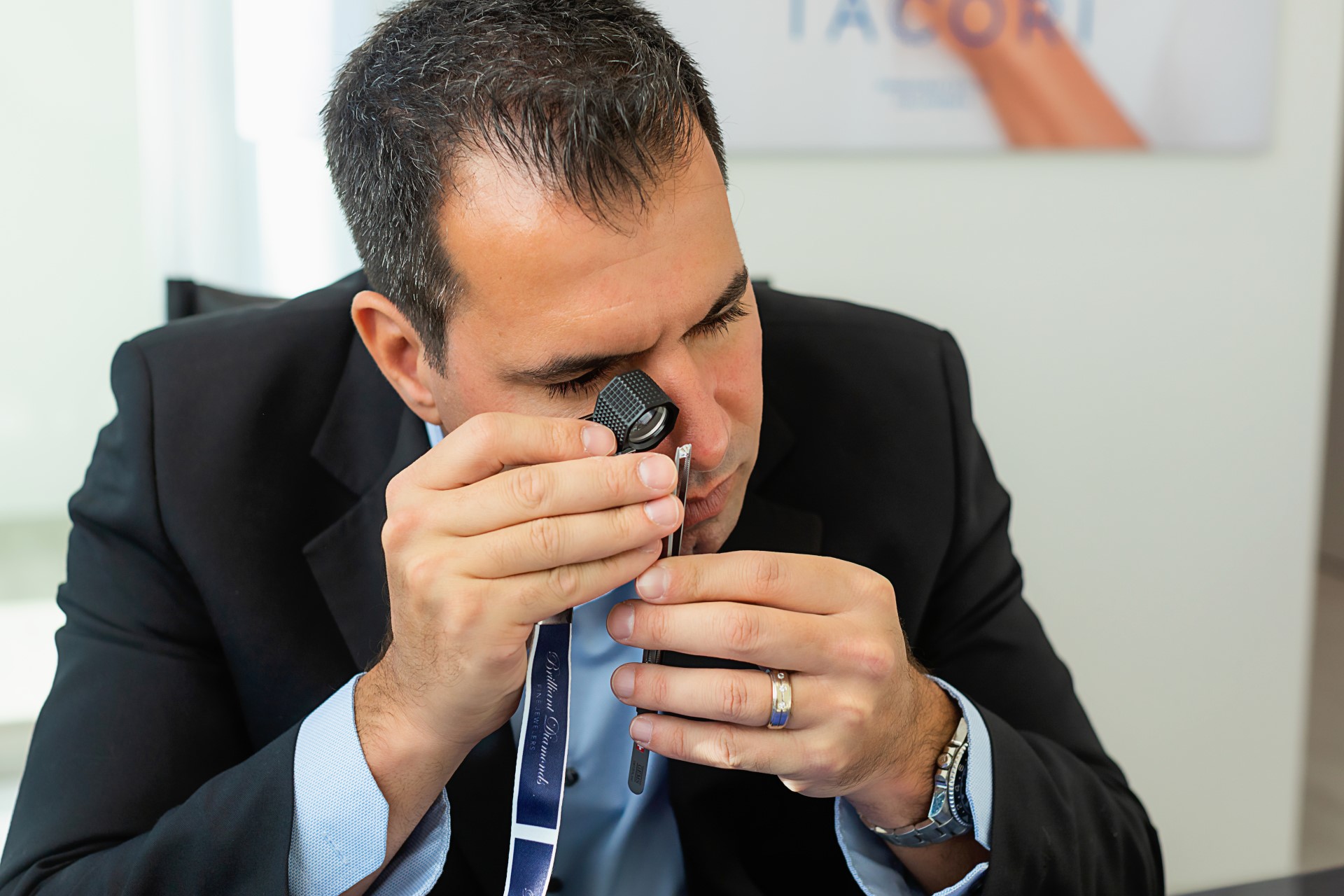
Ariel Berko
Ariel has been working in the diamond industry in San Diego since 1995, bringing decades of hands-on experience and a deep-rooted family background in fine jewelry. A graduate of the Gemological Institute of America (GIA), he is highly trained in diamonds and known for his expertise in both diamond selection and custom jewelry design.
Over the years, Ariel has built a reputation for guiding clients with honesty, precision, and a personalized approach—helping them confidently choose diamonds and create pieces that are both meaningful and enduring.


