

The most expensive diamond on the table isn't always the most beautiful one to the naked eye. When you're searching for the perfect engagement ring, it's natural to feel overwhelmed by the technicality of the diamond clarity scale. You might feel pressured to reach for a "Flawless" grade, fearing that anything less will show visible imperfections. However, the secret to a smart investment lies in understanding what those grades actually mean for the stone's appearance in daily life.
We understand the anxiety of choosing a stone only to notice a tiny speck after the proposal. This guide will help you master the GIA standards so you can find a stunning, eye-clean diamond without paying for features you can't even see. We'll break down the "sweet spot" for value, explain the difference between VVS2 and VS1, and show you how to verify clarity during your visit to our San Diego showroom. You'll gain the confidence to choose a stone that reflects your commitment perfectly and stays within your budget.
Key Takeaways
- Understand that the diamond clarity scale measures rarity rather than visual beauty, helping you avoid paying for grades that don't impact the stone's appearance.
- Learn how to identify eye-clean diamonds that look perfect to the naked eye, which allows you to maximize your budget for a better cut or larger carat weight.
- Distinguish between internal inclusions and surface blemishes to understand how these natural birthmarks affect a stone's character and light performance.
- Discover why viewing diamonds side-by-side in a professional showroom is the only way to truly verify quality and protect your long-term investment.
What is the GIA Diamond Clarity Scale?
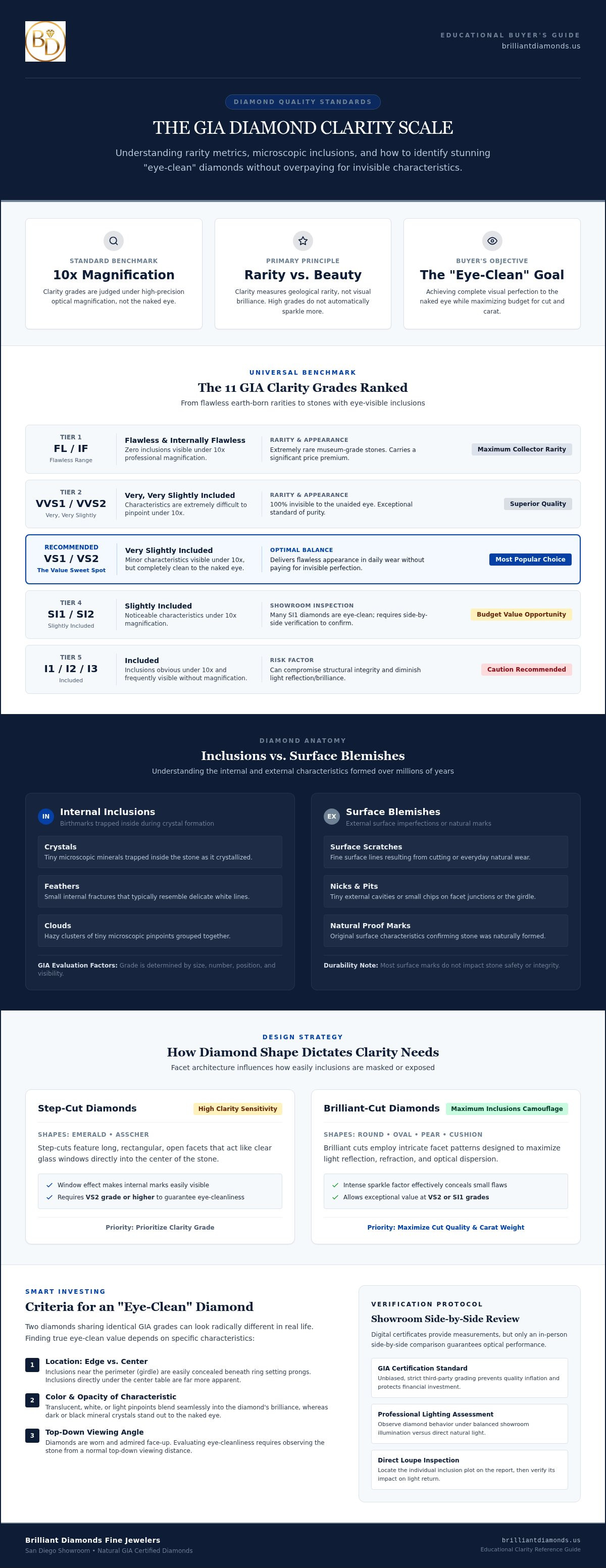
Diamond clarity is a rarity metric determined by the visibility of natural characteristics under 10x magnification. It's essentially the stone's unique fingerprint, formed deep within the earth over millions of years. Experts evaluate these traits using the diamond clarity scale to ensure every stone is judged against a universal benchmark. This process focuses on internal inclusions and surface blemishes that occurred during the diamond's natural formation.
The 11 Grades of Diamond Clarity
The GIA system categorizes diamonds into eleven distinct grades to provide total transparency for buyers. At the pinnacle are Flawless (FL) and Internally Flawless (IF) stones. These are incredibly rare and show no inclusions even under intense professional magnification. Most couples find their perfect balance of quality and value in the Very, Very Slightly Included (VVS1/VVS2) or Very Slightly Included (VS1/VS2) ranges. These diamonds contain tiny characteristics that remain invisible to your naked eye. While Slightly Included (SI1/SI2) and Included (I1-I3) stones are more common, they require careful side-by-side inspection. You'll want to ensure any visible flaws don't compromise the diamond's structural integrity or its ability to reflect light.
Why GIA Certification is Non-Negotiable
Choosing a stone without a reputable report is a significant risk that can lead to overpaying for lower quality. We prioritize Natural GIA Certified Diamonds because other labs often use inconsistent standards. This inconsistency can misrepresent a stone's true quality on the diamond clarity scale. A GIA report acts as an unbiased third-party verification of your investment, providing the security you need for such a meaningful purchase. It ensures that when you're comparing options in our San Diego showroom, you're looking at accurate, honest data. This transparency is the foundation of a lifelong professional relationship, protecting your investment from the very first day.
Inclusions vs. Blemishes: What is Inside Your Diamond?
Every natural diamond carries a unique story written in its anatomy. These characteristics are divided into inclusions, which are internal birthmarks, and blemishes, which are external surface marks. While a blemish might be a tiny scratch or nick, inclusions are minerals or fractures trapped inside as the diamond crystallized. These features are vital because they confirm your stone is a natural creation of the earth rather than a mass-produced simulant. Understanding these nuances on the diamond clarity scale helps you appreciate the stone's rarity without fearing for its durability.
Common Types of Diamond Inclusions
Most inclusions are microscopic and don't affect the diamond's structural integrity. Common types include crystals, which are tiny minerals trapped inside the stone, and feathers, which are small internal fractures that often look like delicate white lines. You might also see clouds, which are hazy clusters of microscopic pinpoints. According to the GIA Diamond Quality Factors, the size, number, and position of these features determine the final grade. Most of these traits are invisible without a jeweler's loupe.
How Diamond Shape Affects Clarity Requirements
Your choice of shape significantly impacts how much clarity matters. Step-cuts, like Emerald or Asscher shapes, have large, open facets that act like windows into the stone. You'll usually need a VS2 or better to ensure these stones look clean. Conversely, brilliant cuts like Round, Oval, or Pear use complex facet patterns to hide inclusions effectively. This sparkle factor allows you to find incredible value further down the diamond clarity scale. If you're unsure which shape suits your style, you can speak with our team to compare different cuts side-by-side in our San Diego showroom.
The Secret to Value: Finding an "Eye-Clean" Diamond
Mastering the diamond clarity scale isn't about chasing the highest grade possible. It's about finding the visual "sweet spot" known as an eye-clean stone. A diamond is considered eye-clean when its inclusions are invisible to the unaided eye from a top-down view. For most buyers, this is the most critical concept for maximizing a budget without sacrificing beauty. While a Flawless diamond is a marvel of nature, a well-chosen VS2 or SI1 stone often looks identical to the naked eye. Choosing eye-clean diamonds allows you to allocate more budget toward Carat weight or Cut quality, ensuring the stone has the presence and sparkle you desire.
Criteria for an Eye-Clean Diamond
Not all diamonds at the same grade are created equal. When you're evaluating stones side-by-side in our showroom, we look at several factors that influence visibility:
- Location: Inclusions positioned near the edges are far easier to hide under a setting's prongs than those in the center.
- Color: White or transparent inclusions are much harder to spot than dark crystals, which can act like tiny magnets for the eye.
- Size and Type: A cluster of microscopic pinpoints is usually less noticeable than one large, dark central crystal.
The Role of Diamond Color in Clarity Perception
The interaction between different quality factors is where true value is found on the diamond clarity scale. Warmer diamond colors, such as those in the G through J range, can sometimes mask certain types of inclusions more effectively than a colorless D or E stone. The slight tint of the diamond body helps camouflage natural characteristics, making the stone appear cleaner than its technical grade might suggest. This principle applies whether you are comparing natural or lab-grown options. To find the perfect balance for your ring, schedule a viewing at our San Diego showroom where you can see these differences for yourself under professional lighting.
Evaluating Clarity in a Professional Showroom
Digital images provide a helpful starting point, but they can't replace the clarity of an in-person inspection. In our San Diego showrooms, we encourage you to view diamonds under multiple lighting conditions. Natural light reveals the stone's true character, while professional spotlighting highlights how it'll perform in a social setting. This side-by-side comparison is the only way to see how various positions on the diamond clarity scale impact the stone's overall brilliance and fire.
Using a jeweler's loupe allows you to peak under the 10x lens and see exactly what the graders saw. It's a fascinating part of the journey that transforms a technical grade into a tangible understanding of your investment. Our local experts act as your guides, helping you balance the delicate trade-offs between clarity, cut, and carat weight to ensure you don't overpay for invisible features.
What to Ask Your Jeweler About Clarity
When you're evaluating a stone, don't hesitate to ask specific questions about its internal characteristics. If a diamond has a feather or a crystal, ask: "Is this inclusion a durability risk?" You should also consider how the stone will be set. Ask if a specific blemish can be covered by a prong in a custom setting. Finally, always ask where the diamond sits on the eye-clean spectrum to ensure it meets your visual standards.
The Brilliant Diamonds Fine Jewelers Experience in San Diego
We believe in an education-first approach that empowers you to make an informed decision. Our San Diego showrooms offer a transparent environment where you can view GIA certificates alongside the physical stones. This process ensures you understand exactly what you're purchasing, building a foundation for a lifelong professional relationship. We invite you to see the difference that expert guidance and side-by-side comparisons make. Schedule your personalized diamond consultation in San Diego today to find the perfect stone for your commitment.
Begin Your Journey Toward the Perfect Diamond
Selecting an engagement ring is a significant milestone that deserves both technical precision and personal care. By mastering the diamond clarity scale, you've moved past the confusion of technical jargon to focus on what truly matters: visual beauty and honest value. You now understand that an eye-clean stone offers the same stunning appearance as a flawless one while allowing you to prioritize a superior cut or a larger carat weight. This knowledge empowers you to make a decision based on transparency rather than marketing pressure.
The final step in your journey is to see these stones side-by-side. We invite you to view our collection of ethically sourced, Natural GIA Certified Diamonds in person at our San Diego showrooms. Our team is dedicated to providing the expert guidance you need to protect your investment, fostering a lifelong professional relationship built on trust. Book a Consultation with a Diamond Expert today to find a stone that reflects your unique commitment. We look forward to welcoming you into our community.
Frequently Asked Questions
What is the best clarity grade for an engagement ring?
The "best" grade is often the one that provides an eye-clean appearance at the most efficient price point. Most buyers find that VS2 or SI1 diamonds offer the perfect balance on the diamond clarity scale. These stones look flawless to the unaided eye but cost significantly less than higher categories. We recommend viewing stones side-by-side in our San Diego showroom to find your specific preference.
Is a VVS2 diamond better than a VS1 diamond?
On the technical GIA scale, VVS2 is a higher grade than VS1 because it has fewer or smaller inclusions. However, "better" is subjective when both stones look identical to the naked eye. While the VVS2 is rarer, the VS1 often provides superior value for your investment. In a professional setting, we show you how these microscopic differences don't necessarily change the sparkle of your ring.
Can you see SI1 inclusions with the naked eye?
Most SI1 diamonds are eye-clean, meaning their natural characteristics aren't visible without 10x magnification. However, visibility depends on the inclusion's size, color, and location within the stone. A dark crystal in the center might be visible, while a white feather near the edge remains hidden. Visiting our San Diego locations allows you to inspect these details personally to ensure the stone meets your standards.
Do lab-grown diamonds have the same clarity scale as natural diamonds?
Yes, laboratory-grown diamonds are graded using the exact same diamond clarity scale as natural stones. Because they are chemically and physically identical to natural diamonds, they develop similar internal characteristics like crystals or clouds during the growth process. Whether you choose a natural or sustainable lab-grown option, GIA certification remains the standard for ensuring your stone's quality and clarity are accurately represented and verified by experts.
Does diamond clarity affect the price of a ring significantly?
Clarity is one of the primary factors influencing a diamond's rarity and market value. As you move up the scale toward Flawless, prices increase because those stones are harder to find in nature. However, by choosing an eye-clean stone in the VS or SI range, you can save substantially without compromising visual quality. This allows you to focus your budget on a higher cut grade for better brilliance.
Article by
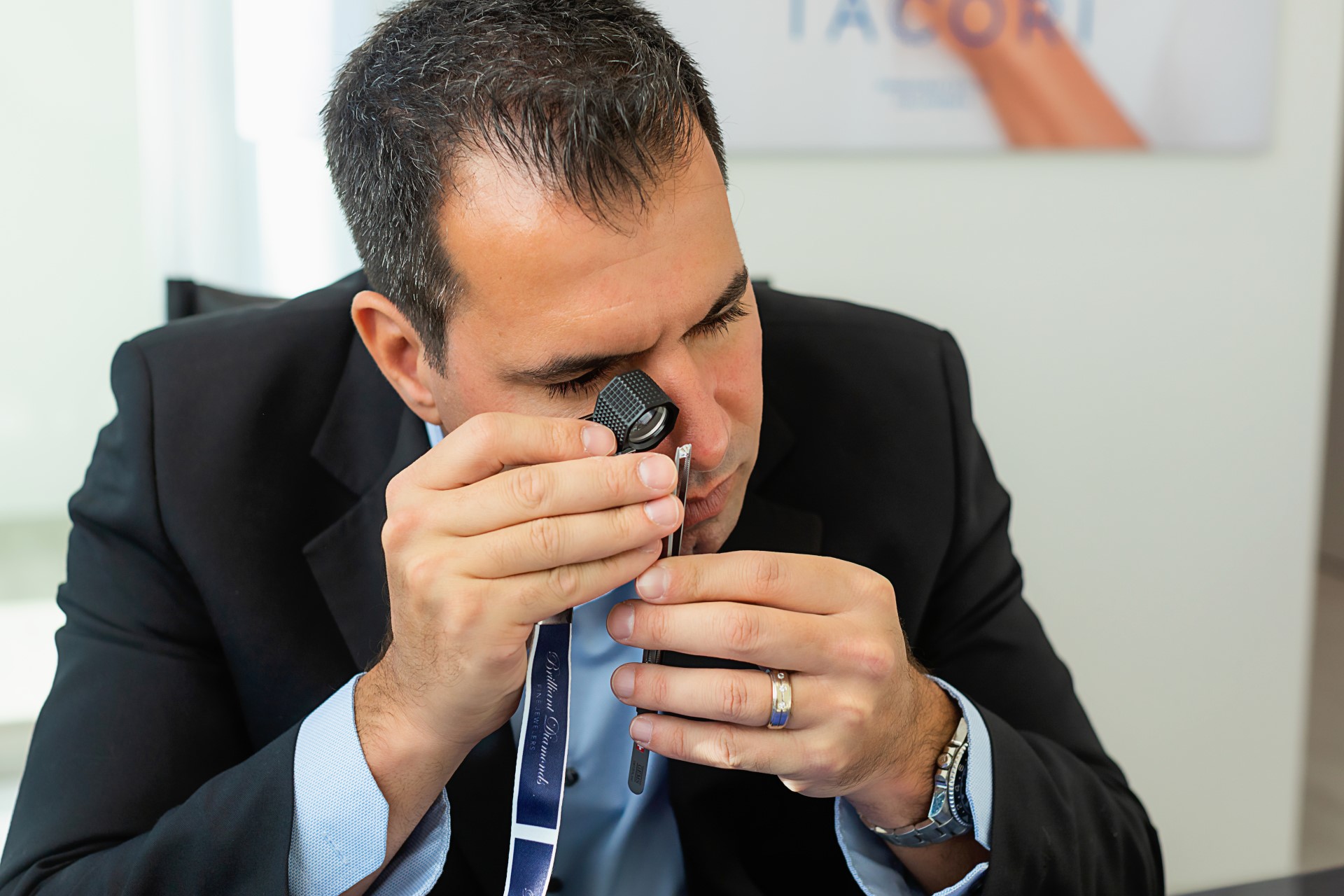
Ariel Berko
Ariel has been working in the diamond industry in San Diego since 1995, bringing decades of hands-on experience and a deep-rooted family background in fine jewelry. A graduate of the Gemological Institute of America (GIA), he is highly trained in diamonds and known for his expertise in both diamond selection and custom jewelry design.
Over the years, Ariel has built a reputation for guiding clients with honesty, precision, and a personalized approach—helping them confidently choose diamonds and create pieces that are both meaningful and enduring.


